
For a minority language such as Ladin to survive in today’s contemporary social context, it needs an official body dealing with language planning and language policy. In the province of Belluno this role was performed by the now closed Istituto ladin de la Dolomites. At present these functions are partly delegated to the Province and to the Ladin Unions (which, however, are voluntary associations). Re-establishing a linguistic and cultural body for the protection of Ladin is therefore both urgent and necessary.
Language help desk
Article 9 of Law 482/1999 allows, in the offices of public administrations, the use of the recognised minority language, both spoken and written. To this end, public administrations in linguistic minority areas are required to ensure the presence of staff able to respond to requests from the public using the protected language. Should they not have staff suited to these tasks, they are allowed to enter into specific agreements with other bodies, public or private. The Ladin language help desk is therefore the tool through which a public administration guarantees users the right to communicate in Ladin.
The language help desk is part of the administration in which it is located. The help desk officer is an employee whose work is carried out, to a large extent, in direct contact with the public, made up essentially of citizens who use the protected language. The officer acts as an active interface between the administration and the local area for the promotion and protection of the Ladin language: the officer therefore does not merely receive and respond to the requests of users who express themselves in the minority language, but takes in and passes on and, within the limits of their remit, carries out the proposals and initiatives coming from either side. The use of the minority language in public life, and in particular in the administrative sphere, is in itself a concrete form of promotion, helping to raise its status.
The Ladin language help desks of the local authorities within the Province of Belluno are currently, and it is hoped only temporarily (2023-2026), entrusted through specific agreements to bilingual staff of the provincial Ladin Unions.

The help desk operator carries out the following activities:
- provides information in Ladin on the activities of the public body in which they work;
- produces bilingual versions of the forms, information material, noticeboard announcements, citizens’ guide to services and website of the body in which they work;
- promotes the use of the Ladin language among public administration staff;
- prepares and distributes information material for citizens on the rights and opportunities deriving from legislation on the protection of linguistic minorities;
- is responsible for the promotion and management of specific projects to promote the Ladin language;
- publicises, provides language advice on and coordinates the language protection and promotion activities planned by other local bodies and associations.
(for further information, see “Il Vademecum degli sportelli linguistici” published by the Consorzio Universitario del Friuli and “Bilinguism aministratif te Fascia” published by the Comprensorio ladino di Fassa)
Language consultancy
The task of an official language body is therefore to promote and enhance the language in the local area and to provide consultancy for translations and adaptations. This brings out the support given to all those who today try their hand at the Ladin language (both private individuals and public bodies), especially in its written form.
For example, from its foundation the Istituto ladin de la Dolomites provided the area with a basic working tool, by creating and proposing unified orthographic transcription rules for the local Ladin varieties. As a result, linguistic consultancy in practice consists of correcting texts, whether newly written or transcriptions of existing ones, but also of teaching the various authors to apply for themselves the rules of the spelling familiarly known as “the Institute’s”. The Institute also acted as a genuine interface between authors and the many valuable Ladin dictionaries, providing practical solutions to the former and making full use of the latter. Last but not least, above all because of the difficulty and the amount of work involved, came the Institute’s promotion and support of major works of transcription and, increasingly, of digitisation, for example of dictionaries.
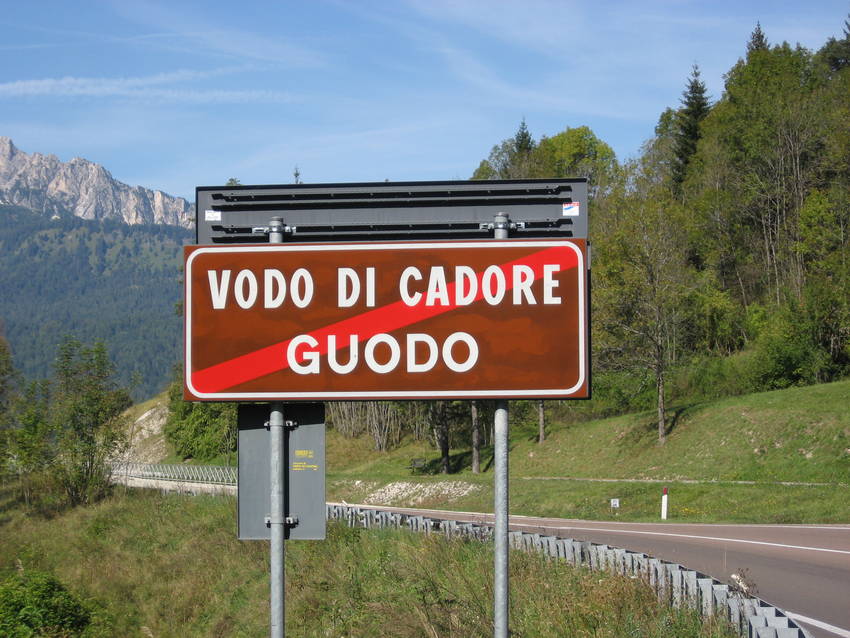
Of considerable importance, and ever more frequent, is the contribution made to municipal administrations when they decide to put up bilingual Italian and Ladin road signs: translation proposals are validated and their transcriptions are adjusted. Advice in the field of place names is of prime importance in fostering a linguistic landscape in Ladin.
Training courses
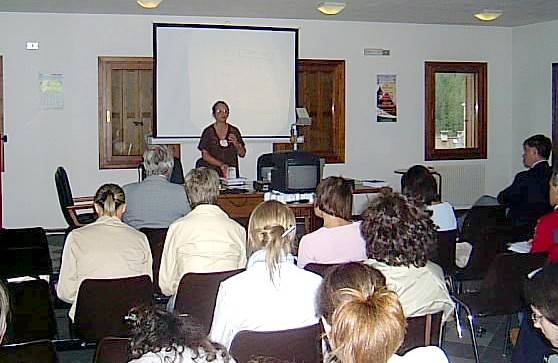
An official language body must also be a point of reference as a training centre. One need only think of training for school teachers, but also for the local population, tourism operators and public administration employees, whether Ladin speakers or not. It must also maintain relations with the academic world, especially with a view to teacher training.
The courses may be general ones on Ladin history and culture, but also purely language courses. The body should therefore be a certifying body for official language examinations able to provide valid and recognised certification of language proficiency, according to the international proficiency levels (A1-C2).
In the past, following various courses, the Istituto ladin de la Dolomites, often acting directly as publisher, was able to publish the proceedings of its courses (e.g. the series “Ladini Oggi”).